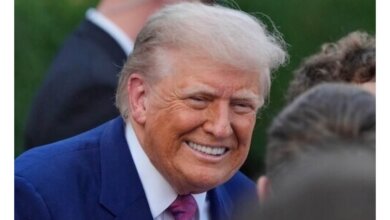
New Delhi/Washington: In a significant escalation of trade and diplomatic tensions, U.S. President Donald Trump has issued an executive order doubling tariffs on Indian imports to 50%, citing India’s continued energy trade with Russia. The order, signed on August 6, 2025, comes into partial effect on August 7, with the additional 25% levy scheduled to be fully implemented after a 21-day window.
India’s Ministry of External Affairs (MEA) swiftly condemned the move as “unfair, unjustified, and unreasonable,” accusing Washington of double standards while reaffirming India’s sovereign right to secure affordable energy supplies.
Tariffs, Trade Deficits, and Energy Diplomacy
Since returning to office in January 2025, President Trump has pursued an aggressive protectionist strategy, raising average U.S. tariffs to historic levels. Citing a $971 billion trade deficit in 2024 as a national emergency, Trump invoked the International Emergency Economic Powers Act (IEEPA) to target countries with large trade surpluses or perceived unfair trade practices.
India, with a $45.8 billion trade surplus with the U.S. in 2024, has come under increasing scrutiny. Trump has long criticized India’s tariff structure—averaging 12% and reaching 70% in some sectors—labeling the country a “tariff king.” However, the current escalation is directly tied to India’s continued import of Russian crude oil, which now comprises over one-third of India’s oil intake.
Tariff Escalation Timeline
July 30, 2025: Trump announced a 25% tariff on Indian goods, effective August 7, citing India’s Russian oil purchases and military ties. He also hinted at an unspecified “penalty” for India’s energy trade.
August 4, 2025: Trump threatened to “substantially raise” tariffs on India, accusing it of profiting from reselling Russian oil on the open market. He claimed India was “fuelling the Russian war machine” and showed indifference to Ukraine’s casualties.
August 6, 2025: Trump signed an executive order imposing an additional 25% tariff, bringing the total to 50%, effective after 21 days. The order cited India’s direct and indirect imports of Russian oil as undermining U.S. efforts to counter Russia’s actions in Ukraine.
August 6, 2025: India’s MEA responded, calling the tariffs “unjustified” and highlighting Western “double standards” in trading with Russia while criticizing India.
Economic Impact on India
The 50% tariff, among the highest imposed on any U.S. trading partner—matching Brazil and exceeding Switzerland (39%), Syria (41%), and Myanmar (40%)—is expected to significantly disrupt India’s $86.5 billion export market to the U.S. The Federation of Indian Export Organisations (FIEO) estimates that 55% of Indian exports, particularly textiles, leather, and marine products, will be directly affected, with micro, small, and medium enterprises (MSMEs) facing the brunt. The Global Trade Research Initiative (GTRI) projects a potential 40–50% drop in U.S.-bound exports.
-
Sectoral Fallout: Textiles ($8.5 billion), gems and jewelry ($9.2 billion), and auto components ($2.1 billion) face reduced competitiveness compared to countries like Pakistan (19% tariff) and Vietnam (20%). Some U.S. buyers are reportedly shifting to Chinese suppliers, despite higher tariffs, due to cost advantages.
-
Economic Projections: Fitch Ratings revised India’s 2025–26 GDP growth forecast to 6.3% from 6.4%, with ICRA estimating a 0.4% GDP loss if penalties intensify. The Indian rupee dropped 0.17% against the dollar, and the BSE Sensex fell 0.38% after the announcement.
-
Exemptions: Pharmaceuticals ($10.5 billion) and smartphones ($14.6 billion), including iPhones produced in India, are exempt pending a U.S. Commerce Department Section 232 investigation into national security impacts. This provides some relief, as India produced 44% of U.S. smartphone imports in 2024.
Despite the tariff hike, India’s economy, driven by domestic consumption, is expected to remain resilient, with exports to the U.S. constituting 2–3% of GDP. Exporters front-loaded $25.51 billion in shipments in April–June 2025 to mitigate losses.
The hike—now among the highest U.S. tariffs globally—poses significant risks to Indian exporters, especially small and medium-sized enterprises (MSMEs). According to the Federation of Indian Export Organisations (FIEO), an estimated 55% of exports to the U.S. are directly impacted. Key sectors under pressure include:
-
Textiles: $8.5 billion in exports face stiff price competition.
-
Gems and Jewelry: $9.2 billion at risk, with buyers shifting to alternative suppliers.
-
Auto Components: $2.1 billion affected, threatening thousands of jobs.
Analysts from the Global Trade Research Initiative (GTRI) warn of a potential 40–50% drop in exports to the U.S. if the tariffs remain in place. Fitch Ratings revised India’s GDP forecast for 2025–26 down to 6.3%, citing trade headwinds, while the BSE Sensex fell 0.38% in reaction to the news.
Exemptions and Temporary Relief
Some key sectors have been temporarily shielded:
-
Pharmaceuticals: India’s $10.5 billion pharma exports, vital to U.S. healthcare supply chains, remain exempt.
-
Smartphones: Devices including iPhones, which constitute $14.6 billion in exports, are exempt pending a national security review by the U.S. Commerce Department.
These carve-outs provide temporary relief but may be revisited depending on geopolitical developments.
India’s Energy Imperative: The Russian Oil Equation
India’s growing dependence on Russian oil stems from strategic and economic imperatives. As the world’s third-largest oil consumer, India imports nearly 80% of its crude requirements. Russian supplies, offered at discounted rates, help manage domestic inflation and reduce global energy price volatility. Indian officials argue that this benefits not just India, but global markets, including the U.S.
While Western nations push India to curtail these imports, the MEA contends that post-2022, the U.S. and EU effectively encouraged such trade under a price cap regime. In 2024, EU-Russia trade totaled €67.5 billion, while the U.S. imported Russian uranium and palladium. India has framed its stance as one based on necessity, not ideology.
Strategic and Diplomatic Response
India has adopted a balanced approach, emphasizing its sovereign right to energy security while seeking to de-escalate the situation.
-
Commerce Measures: Union Minister Piyush Goyal has proposed easing compliance costs and improving access to credit for exporters, particularly MSMEs. Diversification efforts are underway to expand into Southeast Asia and the Middle East.
-
Diplomatic Channels: High-level talks are being maintained. Foreign Secretary Vikram Misri and NSA Ajit Doval are in active dialogue with U.S. counterparts, while Doval’s scheduled visit to Moscow underscores India’s commitment to strategic autonomy.
-
Bilateral Trade Talks: India continues to push for a Bilateral Trade Agreement (BTA), with the next round of negotiations set for August 25 in New Delhi.
Rahul Gandhi and other opposition leaders have accused the Modi government of “reckless diplomacy,” blaming its Russia policy for the fallout.
-

-

-
-
-

-

-
-

-

-