KGMU Needs a Stronger Common Equipment Cell
Professional Equipment Management Is Essential for Better Healthcare

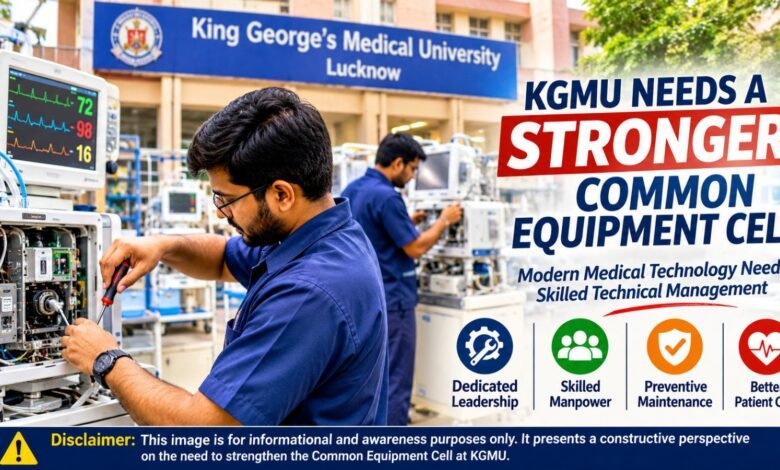
KGMU’s Accreditation Goals Need a Strong Technical Backbone: Why a Professionally Managed Common Equipment Cell Matters
Lucknow: Accreditation is not simply about maintaining files, displaying certificates or preparing for an inspection. It is a continuous institutional commitment to quality, patient safety, technical competence and accountability. For a major tertiary-care medical institution such as King George’s Medical University (KGMU), maintaining these standards requires every supporting department and administrative unit to function with clearly defined responsibilities.
Among the important but often less visible components of hospital quality management is the Common Equipment Cell (CEC). Its role deserves greater attention in the context of accreditation readiness, quality assurance and the effective management of medical equipment across the university.
Modern accreditation frameworks place considerable importance on how hospitals manage their equipment. Proper inventories, maintenance schedules, calibration wherever applicable, qualified technical personnel, breakdown records and equipment safety are not merely desirable administrative practices. They form part of the documented quality systems expected of healthcare organisations.
This makes a professionally structured Common Equipment Cell an important requirement for strengthening KGMU’s institutional quality framework.
Accreditation begins with systems, not certificates
The true value of accreditation lies in the systems established to maintain quality every day.
Hospital accreditation evaluates multiple aspects of institutional functioning, including patient care, safety, infrastructure, governance, documentation and quality improvement. These requirements cannot be fulfilled through the efforts of one department alone.
Every supporting service has a role in ensuring that the hospital operates safely and efficiently.
Medical equipment is particularly important because its availability and reliability directly influence clinical services. A ventilator, anaesthesia workstation, patient monitor, infusion pump, defibrillator or diagnostic machine must be appropriately maintained and monitored throughout its operational life.
An equipment management system that depends largely on individual departments to arrange technical support may find it difficult to maintain uniform documentation and consistent monitoring across a large institution.
A strengthened Common Equipment Cell could provide the central technical coordination needed to bring greater consistency to these activities.
NABH standards highlight the importance of medical equipment management
The National Accreditation Board for Hospitals and Healthcare Providers (NABH) has specifically addressed medical equipment management under its hospital accreditation standards.
The sixth edition of the NABH Hospital Accreditation Standards, issued in January 2025, includes Standard FMS.5, which requires the organisation to have a programme for medical equipment management.
The standard covers equipment planning according to institutional services, inventory and maintenance records, implementation of preventive and breakdown maintenance, periodic inspection and calibration, qualified and trained personnel, and guidance for equipment replacement and disposal.
These requirements demonstrate why equipment management should be treated as a structured institutional responsibility rather than an occasional maintenance activity.
For KGMU, strengthening the CEC would provide an opportunity to develop a more organised mechanism for supporting these requirements across departments.
The objective should be to ensure that equipment-related documentation and technical services are consistently maintained, readily accessible and capable of demonstrating compliance during internal and external quality assessments.
The need for qualified technical leadership
A quality-oriented equipment management system requires appropriate professional leadership.
The Common Equipment Cell should have a dedicated in-charge with relevant qualifications and experience in biomedical equipment management, supported by an adequate team of trained technical personnel.
The responsibility involves equipment planning, inventory supervision, preventive maintenance, technical inspections, service coordination, breakdown monitoring, calibration tracking and maintenance documentation.
These functions require specialised technical knowledge and continuous administrative attention.
Doctors have an important role in determining clinical requirements, assessing equipment suitability and providing feedback on performance. However, clinical responsibilities and technical equipment management are different areas of professional work.
A structured system should allow doctors to contribute their clinical expertise while qualified biomedical engineers and technical professionals undertake the specialised equipment management functions.
Such a division of responsibilities would improve coordination and help ensure that accreditation-related technical requirements receive consistent attention.
Preventive maintenance: An important accreditation requirement
One of the most important areas in equipment management is preventive maintenance.
A hospital cannot rely entirely on breakdown-based repairs and expect to maintain a consistently reliable equipment system.
Preventive maintenance should be planned according to equipment type, manufacturer recommendations, operational requirements and applicable standards.
Each machine should have an identifiable maintenance history, including installation details, warranty information, servicing schedules, breakdown reports and repair records.
The CEC could coordinate equipment-wise maintenance calendars and monitor compliance with scheduled servicing.
A digital reminder and reporting mechanism would help identify overdue maintenance and ensure that departments receive timely technical support.
For critical equipment, downtime should be monitored from the initial complaint to inspection, repair and restoration.
Such documentation would be valuable not only for daily hospital functioning but also for demonstrating the effectiveness of the equipment management programme during accreditation assessments.
Calibration and safety require systematic monitoring
Calibration and performance verification are important wherever applicable to the particular equipment and its intended use.
An organised system should identify which instruments require calibration, the appropriate frequency, the competent service provider and the next due date.
Records of calibration, inspection and testing should be maintained in a standardised format.
Similarly, equipment safety should receive regular attention through appropriate electrical safety checks, functional testing and technical inspections.
The Common Equipment Cell could maintain a centralised database containing the relevant details and coordinate with authorised agencies wherever specialised services are required.
This would help prevent missed schedules and improve the availability of supporting records during quality audits.
NABL requirements and laboratory equipment
Another important dimension is the role of laboratory equipment in accreditation and quality assurance.
NABL, the National Accreditation Board for Testing and Calibration Laboratories, grants accreditation to medical laboratories under ISO 15189 and to calibration laboratories under the applicable ISO/IEC 17025 framework.
Its requirements include equipment competence, appropriate calibration, metrological traceability wherever applicable, equipment identification and maintenance of relevant records.
For KGMU’s laboratories and diagnostic services, a well-organised technical support mechanism can assist with equipment inventory, maintenance coordination and calibration tracking.
However, NABL accreditation is granted to the eligible laboratory or conformity assessment body within its defined scope. A central equipment cell does not itself receive NABL accreditation simply by managing equipment.
Its contribution is to support the technical and documentation requirements of the respective accredited or accreditation-seeking units.
This distinction is important when planning the institutional quality framework.
Documentation must be ready throughout the year
Accreditation readiness should never become a last-minute exercise.
A common difficulty in large institutions is that equipment-related information may be maintained in different departments, registers and individual records.
When documentation is not standardised, retrieving information during an assessment can become unnecessarily time-consuming.
A centralised digital equipment management system could address this issue.
It should ideally include:
– A unique identification number for each item of equipment.
– Department-wise and location-wise inventory.
– Installation, warranty and service contract details.
– Preventive maintenance schedules.
– Breakdown and repair history.
– Calibration and safety-testing records, wherever applicable.
– Equipment downtime and restoration details.
– Replacement and condemnation records.
– Training records for personnel operating equipment.
– Periodic compliance and performance reports.
This would provide the university with a more reliable overview of its equipment resources and improve the availability of records required for quality assessments.
Skilled manpower is essential for sustained compliance
A well-designed policy cannot deliver results without the personnel required to implement it.
The Common Equipment Cell should be reviewed in terms of its present staffing pattern, technical competencies, workload and institutional requirements.
Adequate biomedical engineers, qualified technicians and appropriate administrative support are necessary for a large tertiary-care hospital.
Technical manpower should be deployed according to the number and complexity of equipment, geographical distribution of clinical departments and maintenance workload.
Periodic training is equally important. Medical technology changes rapidly, and personnel responsible for equipment management must remain familiar with newer systems, safety requirements and maintenance procedures.
A technically competent team would help the CEC move from a predominantly reactive arrangement towards a planned and quality-driven service.
A central mechanism for internal quality audits
The university could also consider integrating the Common Equipment Cell into its internal quality assurance and accreditation preparedness activities.
Periodic internal audits of equipment management could examine whether maintenance schedules are being followed, calibration records are current, breakdowns are properly documented and equipment status is accurately reflected in departmental records.
The findings could be reviewed through an appropriate institutional quality mechanism.
Departments requiring additional support could be identified, and corrective actions could be monitored within defined timelines.
Such reviews would make the CEC an active participant in continuous quality improvement rather than simply a point of contact for equipment-related complaints.
Better equipment management means better patient care
Accreditation should ultimately improve the quality of services received by patients.
A hospital may possess sophisticated equipment, but its clinical value depends on whether that equipment is functional, safe, properly maintained and available when required.
A reliable Common Equipment Cell can contribute to reduced avoidable downtime, better maintenance planning, improved coordination and more effective utilisation of public resources.
It can also help clinical departments concentrate on patient care while technical personnel undertake the specialised responsibilities associated with equipment management.
For a university that provides tertiary-level healthcare and postgraduate medical education, these improvements have significance well beyond administrative convenience.
The way forward for KGMU
Strengthening the Common Equipment Cell should be considered an important component of KGMU’s broader quality assurance and accreditation preparedness strategy.
A phased institutional plan could begin with an assessment of the existing unit, followed by the appointment of dedicated technical leadership, deployment of adequate skilled manpower and development of standard operating procedures.
The university could then introduce a centralised equipment inventory, preventive maintenance schedules, calibration monitoring, breakdown tracking and periodic internal audits.
The CEC should also have clearly defined reporting arrangements and coordination with the institutional quality assurance and accreditation teams.
Its performance could be reviewed through measurable indicators such as preventive maintenance compliance, equipment downtime, complaint resolution time, calibration compliance and completeness of equipment records.
These measures would help the administration assess actual performance rather than relying only on the existence of policies and registers.
Accreditation is a continuous responsibility
For KGMU, the objective should be to build a system that remains accreditation-ready throughout the year.
The Common Equipment Cell may not be the most visible part of a hospital, but its contribution to safety, operational efficiency and quality documentation is substantial.
A technically qualified in-charge, trained biomedical manpower, proper equipment records and a systematic maintenance programme would give the university a stronger foundation for meeting applicable accreditation requirements.
Ultimately, accreditation is a reflection of how effectively an institution translates quality standards into everyday practice.
A hospital’s commitment to quality is reflected not only in the equipment it owns, but also in the professional systems it establishes to maintain that equipment, ensure its safety and keep it ready for patient care.
Strengthening the Common Equipment Cell would therefore be a practical and meaningful step towards a more accountable, efficient and accreditation-ready KGMU.
Editorial note: This article presents a constructive institutional improvement perspective. NABH and NABL references are based on their published standards and guidance. It does not make any claim about the current accreditation status or compliance level of KGMU or any individual department.
ताज़ा खबरें सबसे पहले पाएं
WhatsApp Channel, Google News और सोशल मीडिया पर फॉलो करें