World Stroke Day 2025: Every Minute Counts Recognize Signs, Act Fast, Save Lives

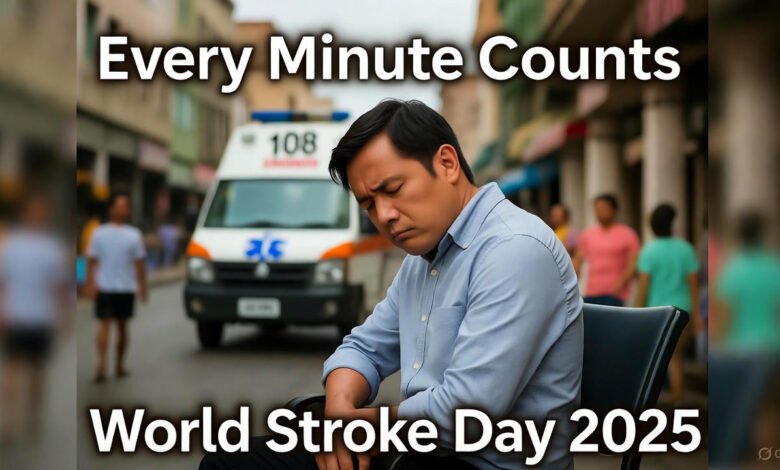
LUCKNOW: Imagine this: every time you blink, someone, somewhere, suffers a stroke. Every two seconds, a life is cut short or forever changed. That’s the brutal global reality of a disease that doesn’t knock it bursts in.
As per statistics, about 12 million people worldwide suffer a stroke annually, and 6.5 million die as a result. About one in four adults over the age of 25 will experience a stroke in their lifetime. Two-thirds of survivors face long-term complications, including paralysis, speech loss, and cognitive impairment. Over 60% of strokes occur in people under 70 and 16% in those under 50.
In India, rising rates of hypertension, diabetes, irregular heartbeat, and sedentary lifestyles have fueled a surge in cases, making public awareness and pre-hospital care more critical than ever.
Strokes are of two types: ischemic stroke and haemorrhagic stroke. Commonly, 80 percent of patients suffer from an ischemic stroke, which can be treated with good outcomes if medical care is received within a window of three hours—or extended to 4.5 hours in some cases, as per the American Heart and Stroke Association.
In most cases, patients and their relatives are not able to identify the symptoms of a stroke or resort to home remedies, resulting in losing the window period.
The world today observes World Stroke Day (29 October) under the critical theme, “Every Minute Counts.” This global initiative, spearheaded by the World Stroke Organization (WSO), stresses the urgent need for heightened awareness, rapid recognition, and timely treatment of stroke—a condition that continues to be a leading cause of death and disability worldwide.
This year, the campaign focuses on the urgency of the “golden hour” – the vital first 60 minutes after symptom onset when timely intervention can prevent irreversible brain damage.
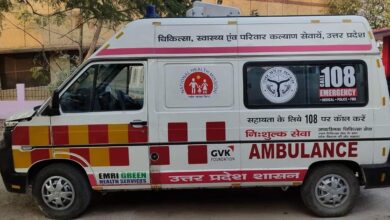
“Time lost is brain lost,” warns EMRI GHS, the force behind the iconic 108 ambulance network in India. In a special message, EMRI GHS says, “Every minute during a stroke, 1.9 million brain cells die. But if we #ActFAST, we can increase the opportunity for effective treatment and reduce long-term disability.”
Know the Signs: Use F.A.S.T.
We can easily identify symptoms using the F.A.S.T. acronym as a simple, life-saving tool:
Face Drooping – “Ek taraf ka muh tedha ho gaya?”
Ask the person to smile and watch their face closely: if one side droops, looks numb, or the mouth corner hangs lower while the other side stays up, it’s a glaring red flag that brain signals to half the face are suddenly blocked. #ActFAST and call 108/112 immediately.
Arm Weakness – “Haath uthao – dono barabar?”
Tell the person to raise both arms straight out for 10 seconds and watch carefully: if one arm drifts downward, feels too weak to hold steady, or can’t rise at all, it’s a clear red flag. #ActFAST and call 108/112 right away.
Speech Difficulty – “Mera naam bolo – saaf bolo.”
Ask them to repeat a simple sentence like “Aaj mausam achha hai” and listen closely: if words come out slurred, jumbled, missing, or they struggle to find the right words, it’s a clear sign the brain’s language center is under attack. #ActFAST and call 108/112 immediately.
Time to Call 108/112 – “Abhi call karo – ek minute bhi mat waste karo!”
The moment even one F.A.S.T. sign appears, grab the phone and dial 108 or 112 without a second’s delay. Tell the operator exactly what’s happening, stay calm, and note the time symptoms started—because every minute wasted kills 1.9 million brain cells. A lightning-fast ambulance response can deliver clot-busting treatment within the golden 4.5-hour window and give the patient the best chance of walking and talking again.
Prevention: 90% of Strokes Are Avoidable
While age, genetics, and family history cannot be changed, nearly all strokes can be prevented through lifestyle modifications:
- Control blood pressure (keep below 120/80)
- Quit smoking and avoid second-hand smoke
- Manage diabetes and cholesterol
- Maintain a healthy weight through regular exercise
- Eat a balanced diet low in salt, sugar, and unhealthy fats
- Limit alcohol consumption
A Call for Collective Action
“Together, we can move from awareness to action and make every minute count.”
On this World Stroke Day, we must build a stroke-ready society where every citizen knows the signs, every ambulance is prepared, every hospital is equipped for treatment, and every minute saved becomes a life reclaimed.